
What does it mean to truly believe? Ibn al-Jawzi, rahimahullah, answers this question in a way that cuts through the surface. True belief — complete, perfect iman — is not merely performing the outward acts of worship. It is a state of the heart in which the servant fully surrenders to his Lord, never objecting, never resisting, and never feeling entitled to anything other than what Allah has decreed.
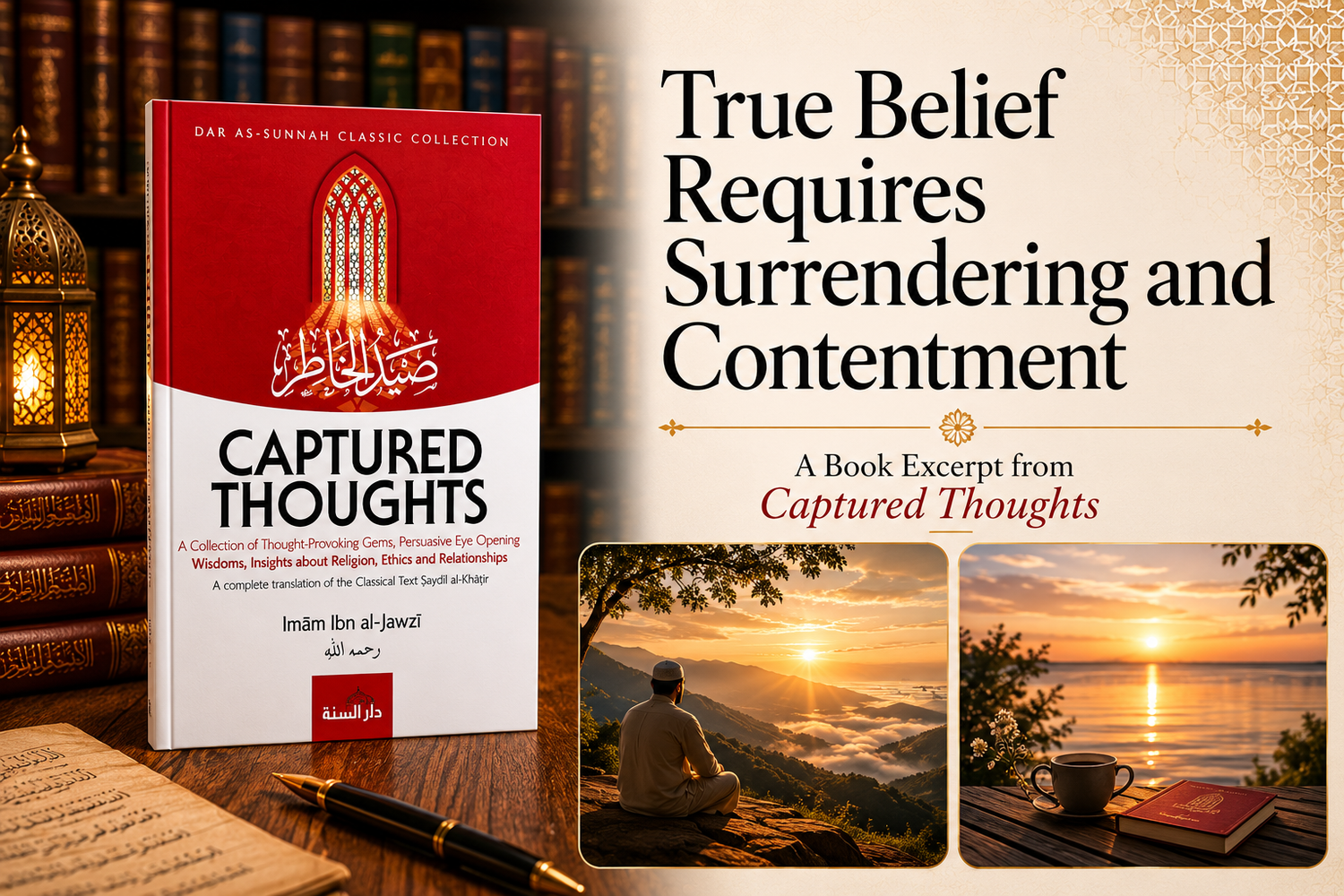
The following is an excerpt from Captured Thoughts by Imam Ibn al-Jawzi, Chapter 187, pages 599–600. This title is coming soon to The Islamic Book Cafe — we will update this post with the product link when it becomes available insha'Allah.
True Belief Requires Surrendering and Contentment
A true believer (mu'min) is not one who merely performs ritualistic worship and avoids prohibitions. Rather he is one who has perfected his belief (kamil al-iman). He never objects to Allah's decree. The more hardship he undergoes, the stronger his belief and submission becomes.
He might pray and his prayer is not answered, yet his belief is never affected — for he realises he is owned, and that his Master directs him as He pleases. If he ever objects, then he exits the state of servitude (maqam al-'ubudiyyah) and enters the state of debate (maqam al-munadhara) — which is what happened to Iblis.
The effect of strong faith becomes clear at the time of hardship (bala').
Some people might wonder why Allah allowed Prophet Yahya, alayhis-salam, to be slaughtered by an evil person, and for other Prophets and believers to be harmed. It would be a form of disbelief to assume that Allah is unable to defend the Prophets. The only thing that can be done is to surrender to the Owner. He feeds some disbelievers and starves some believers. He keeps some wrongdoers healthy and some among the righteous ill.
Prophet Ya'qub, alayhis-salam, cried over his missing son for eighty years and never lost hope. When his second son was taken, he said:
"May Allah return them both to me." (Yusuf 12:83)
Prophet Musa, alayhis-salam, made du'a against Fir'awn but was only answered forty years later — although Fir'awn used to kill Prophets and crucified those who believed.
Many calamities strike a noble person only for him to increase in surrendering (taslim) and contentment (rida). This is when we understand the verse:
"Allah is pleased with them." (Al-Bayyinah 98:8)
Al-Hasan al-Basri said: "People behave the same during good times, but they differ in times of hardship."
Shaykhul-Islam Ibn Taymiyyah, rahimahullah, said: "The servant travels to Allah between recognising Allah's favours upon him, and constantly searching for his own faults in himself or his actions."
A Reflection
Ibn al-Jawzi is describing something the heart of every Muslim must wrestle with: the difference between enduring hardship and truly surrendering to it. Endurance can still carry resentment or the quiet belief that we deserved better. Taslim is something deeper — a recognition that the Owner of all things is directing everything, and that His direction is better than our preference.
The Prophets are our examples. They were tested more severely than anyone — and they surrendered more completely than anyone. That is not a coincidence.
Baarakallahu feekum — The Islamic Book Cafe | Portland, Oregon



Leave a comment
This site is protected by hCaptcha and the hCaptcha Privacy Policy and Terms of Service apply.